Friday, November 30, 2012

Magnesium Lab

Introduction/ Procedure:
Pre-Lab Questions
For this lab we had to conduct a Pre-Lab:   
Which is to the left.


Materials:
The materials we had during this lab is a crucible, a shiny pice of Mg, clay triangle ring and aBunsen burner
Procedure:
First off we put our triangle ring 7cm above the Bunsen burner and then placed the crucible inside the triangle. Then we measured out 25cm of Mg. After that we placed the crucible with the Mg over the flame and waited until we say a spark. Then we placed our Mg inside a beaker with 10ml of water.
Data:

This is our table with all of your measurements and information.


Analysis Questions.
1. With this lab light energy was conducted. This happened when the Mg was heated and sparked.
2. When Mg is reacting with are it changes colors to a blackish color. Anytime you have Mg out in the open it will react.
3. Magnesium oxide and Magnesium nitrate 
4. Magnesium and oxygen because our mixture consisted of a white   product. 
5. The Magnesium compound was conductive but it wasn't a high level of conductivity.


Tuesday, November 27, 2012

Intro to Ionic Bonding and Ionic Compound Formulas Writing


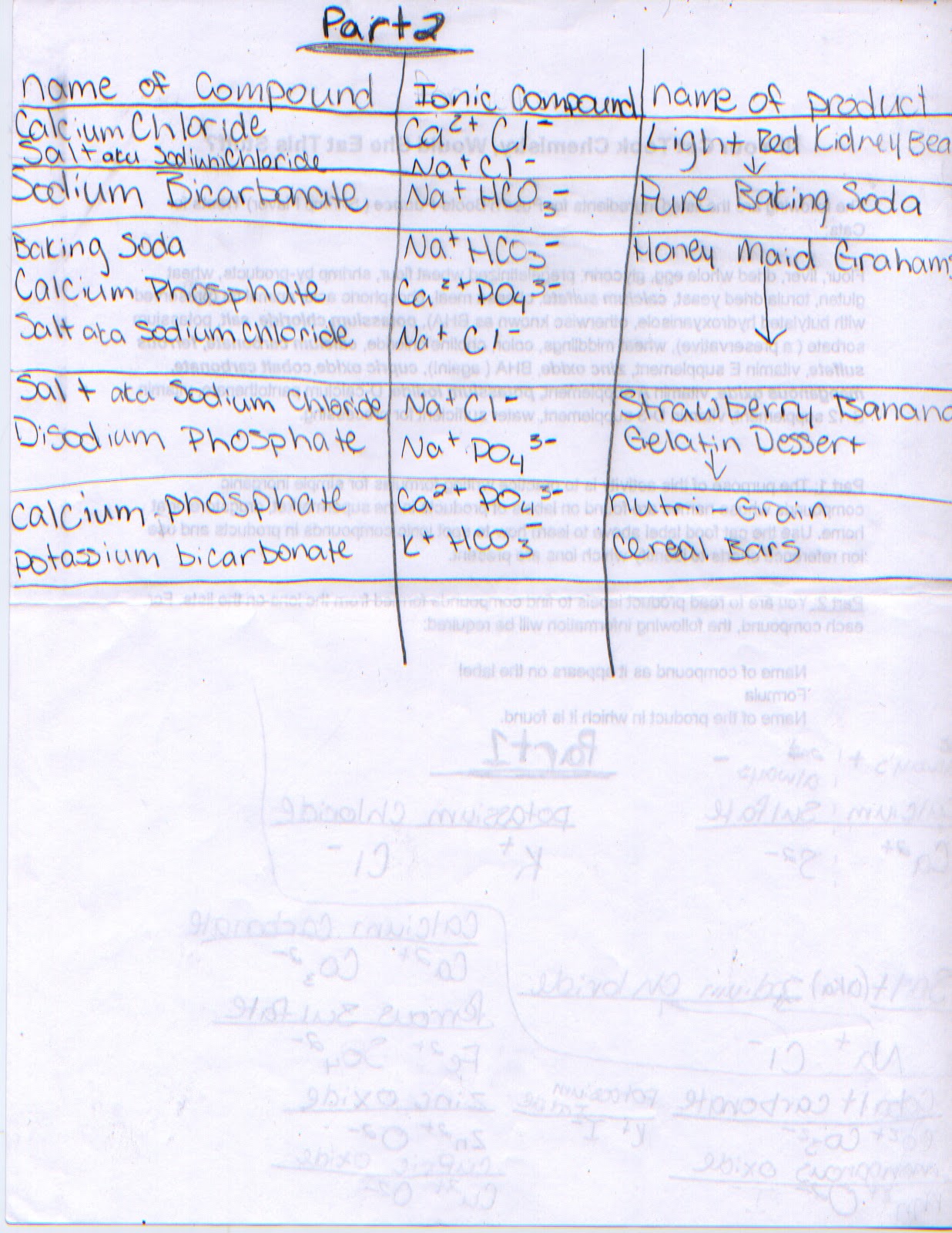
We have currently been studying about chemical formulas and have been learning how to equal them. With this worksheet to the left was the first time we tried playing with the chemicals inside foods we eat. We looked at cat food, granola bars, kidney beans and such. We found these chemicals on the label of the product. Surprisingly there were many chemicals in each product I looked at.


Here are the all the products I looked at and the name of the compound and the Ionic Compound that goes with it. As you can See the compound have numbers and subscripts that go along with an element. They look hard to do but they are actually really easy. Here is and example of a compound and the Ionic Compound that goes with it: Potassium Chloride: KCl it goes this way because Potassium has a positive charge of 1 and Chloride has a negative charge of 1 so the cancel out to KCl with no sub numbers but Tin Sulfide will have a subscript of 2 because Tin has a positive charge of 2 and Sulfide has a negative charge of 1 so you cross the 2 over and the -1 over and you get SnS2 but the two will be a subscript. 


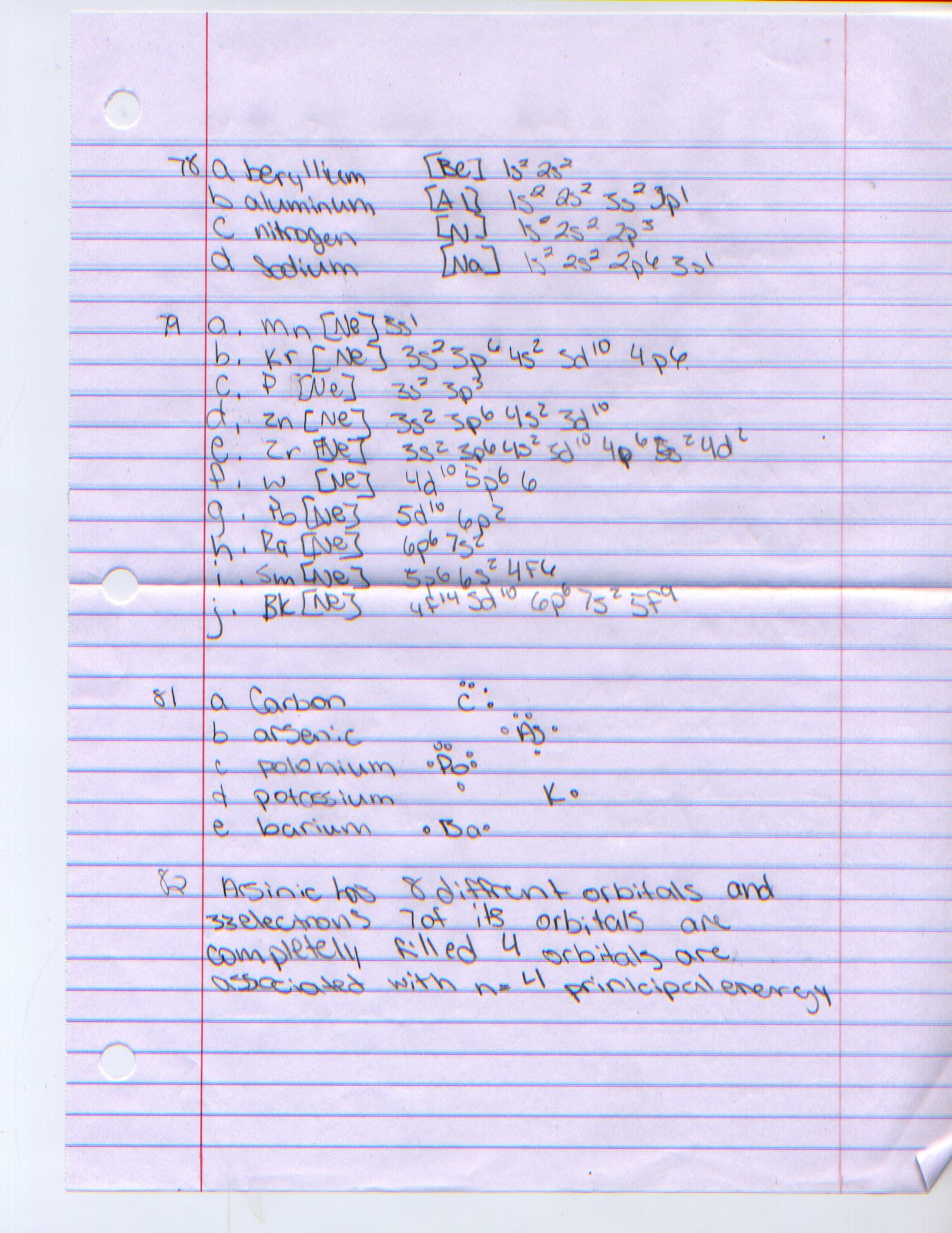
This is another worksheet (left) as a reference to show how to do these.  Also I have some book work( below) to show how awesome I am at these Ionic Compound.


Monday, November 19, 2012

Conductivity Lab

With this lab we tested different conductivity of mixtures. We tested four mixtures and all of them had conductivity. 3 out of 4 mixtures had high conductivity. The other 1 had low conductivity. The slide show will show you procedures in the lab and explanations of what went on in this lab.


Wednesday, November 7, 2012

Elements and Such

We started off by learning about mole day. Mole day is a strange holiday where the holiday starts on 10/23 at 6:02 a.m. and ends some where around 6:02 p.m. The mole is 6.02 x 10^23 this is 1 mole. Amado Avogadro is a scientist of physics and math. He began studied in both but later he began to think of a hypothes that equal volumes of gasses contain the same number of molecules later that hypothesis became a law also known as Avogadro's Law. The mole day has a cute little furry animal called a Mole believe it or not so I created a little foil mole that looked more like a ball of foil than the mole, but the object of creating this mole out of foil is to use .5 mole of aluminum. I weighed the starting foil and was right on but after I created the mole it became heavier because of the crushing the made the volume heavier. Here is a funny mole joke which i take no credit for but i enjoy it still. What is chemical nonsense?.... MOLE-archy:). Here is a youtube video explaining all about the mole:) I really like this website it is kahn acadamy it is a good website to go to if you don't understand something in science and  or in math.


A few days after Mole day we started on a periodic table scavenger hunt and during this worksheet I noticed some trend in the periodic table. Also learned more of the placement of the elements like: 

MetalloidsNonmetals
Other nonmetalsHalogensNoble gases
Metals
Alkali metalsAlkaline earth metalsLanthanoidsTransition metalsPost-transition metals
Actinoids


If you click Periodic Table it will take you to the website I used to do the scavenger hunt. And my paper is below.


After the scavenger hunt I learned that the periodic table has many trends and also that they have trends for a reason.  The periodic table has columns and rows of varying sizes. The reason behind the table's odd shape becomes clear if it is divided into sections, or  blocks,  representing the atom's energy sub level being filled with valence elections. Because there are four different energy sub levels (s, p, d, and f), the periodic table is divided into four distinct blocks. The s block consists of group 1A and 2A, the p block is 3A through 8A, the d- block consists of 3B through 8B and continues through 1B and 2B.  Here are some example problems on my paper that shows I know what the periodic table is about and what consists with in it.


Friday, October 19, 2012

Worksheets

With this blog we did book work about Quantum Mechanics. Quantum Mechanics states that only a certain amount of electrons can be in a shell. The number increases as you continue out from the nucleus. With the first shell it can only hold two electrons, the second shell has eight, the third shell has 18. The levels or shells are also called orbitals. These orbitals have sub-levels starting after the first orbital. Each level starts with the S orbital. The S orbital holds two electrons. When the orbital is filled, you start to fill the sub-levels. The first sub-level is the P. Did you know you can name elements by their orbitals.  An example of electron configurations is Bromine (Br) Bromine has 35 electrons: [Ar]4s23d104p5.


This is my first set of questions:


This is my second set of questions:


Thursday, October 18, 2012

Standard 8

Remebering: What I did in chemistry is
1. Properties of matter blog
2.  Separation Techniques Lab
3. Light and Atoms Review
4.Introduction to Electron Configurations in Atoms

What is important about it:
Each blog was interesting to write and learn whats new in the world of chemistry and just a new insight of the world of chemistry.

Applying:
 I could apply this in everyday life. Well I want to become a nurse so I think I could use this when I go to medical school.

Evaluating:
How I did this 1st quarter I think I did well I kept up with my blogs and kept a steady standard of proficent. So I would say that I did very well for my very first time being in Mr. Ludwigs class.

Creating:
Next quarter I could put some youtube videos, websites, and just more visual effects to my blogs to give a further explanition of what we are studing.

Saturday, October 6, 2012

Light

Did you know that light is a type of electromagnetic radiation? Electromagnetic radiation is a kind of energy and acts like a wave as it travels through a space. (Examples of that incule X ryas, Radio waves, and Microwaves. ) Waves can be characterized by their wavelength, amplitude, frequency, and speed. The shortest distance between equivalent points on a continuous wave is called a wavelength. The height of a wave from the origin to a crest or from the origin to a trough is the aptitude.  Frequency is the number of waves that pass a given point in one second. The SI unit for frequency is Hertz which is the same to one wave per second.
With this diagram you can see what a wavelength, frequency, and what amplitude is and what the symbol is for wavelength.


 I looked through a spectroscope at 9 different lights.. The lights we looked at through the spectra scope are in order from the longest wave length color with the highest frequency (red), then the colors become shorter- orange, yellow, green, blue, indigo, and violet. Violet has the shortest wave length with the lowest friquency. Also with every light we observed it gave off a gas and the gas that I observed had a different spectra for each light. 

My lab with the spectrum and diffrent lights. With the lab is a scale the scale is what was inside the spectrascope the wavelength the higher the number the longer the wavelength and the higher the frequency.

LAB PAGE 1


LAB PAGE 2